
South Africa‘s property investment landscape is changing, and Black women are increasingly becoming part of that transformation. While traditional property ownership has long been dominated by established investor groups, new research suggests that the country’s investment market is gradually opening up to a more diverse generation of property owners.
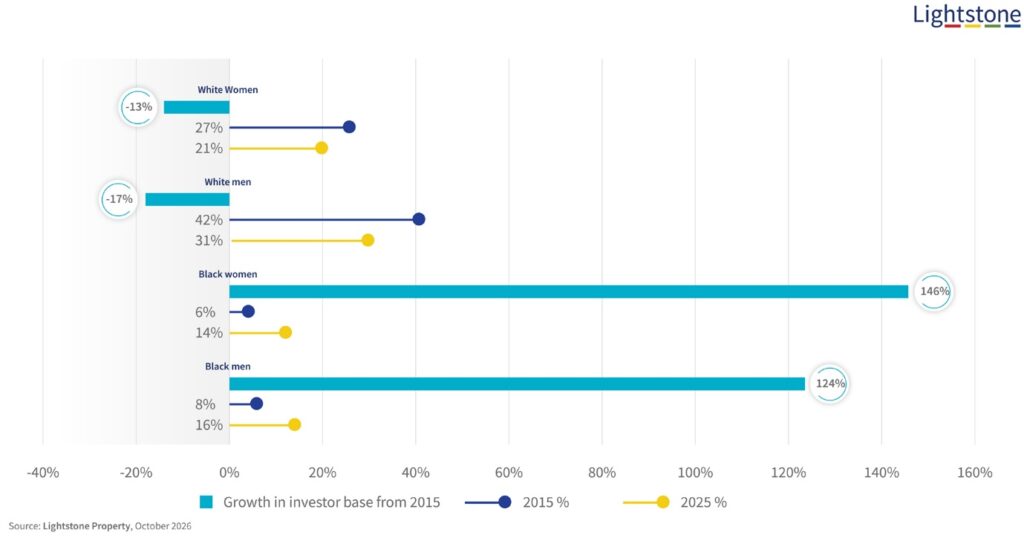
According to property data company Lightstone, South Africa‘s private property investor base grew by approximately 22% between 2015 and 2025, increasing from fewer than 120,000 investors to more than 140,000. More significantly, Black women recorded the fastest growth among the four investor groups analysed by race and gender.
It is a shift worth paying attention to. Beyond property prices and market performance, the numbers point towards changing patterns of wealth creation, financial independence and participation in one of South Africa‘s most established asset classes.
A New Generation Is Entering the Property Market
For decades, property investment has been associated with financial privilege, inherited wealth and access to capital. However, Lightstone’s latest analysis suggests that the investor profile is becoming more diverse.
White men remain the largest group of private property investors, followed by White women. Black male investors number approximately half as many as White male investors, while Black women remain slightly behind Black men in absolute numbers.
But the growth story is particularly interesting.
Black women are entering the market at a faster rate than the other groups analysed. While they have not yet overtaken their counterparts in total numbers, their growing participation signals a gradual change in who gets to build wealth through property.
For young South Africans navigating rising living costs, financial uncertainty and the pressure to build long-term security, this development offers an important perspective: property investment is no longer just about owning a home. It is increasingly part of a broader conversation about building assets and creating financial options.
Smaller Portfolios, Bigger Financial Ambitions
Interestingly, South Africa‘s growing investor base is not being driven by people accumulating massive property empires.
Instead, growth is concentrated among smaller portfolios.
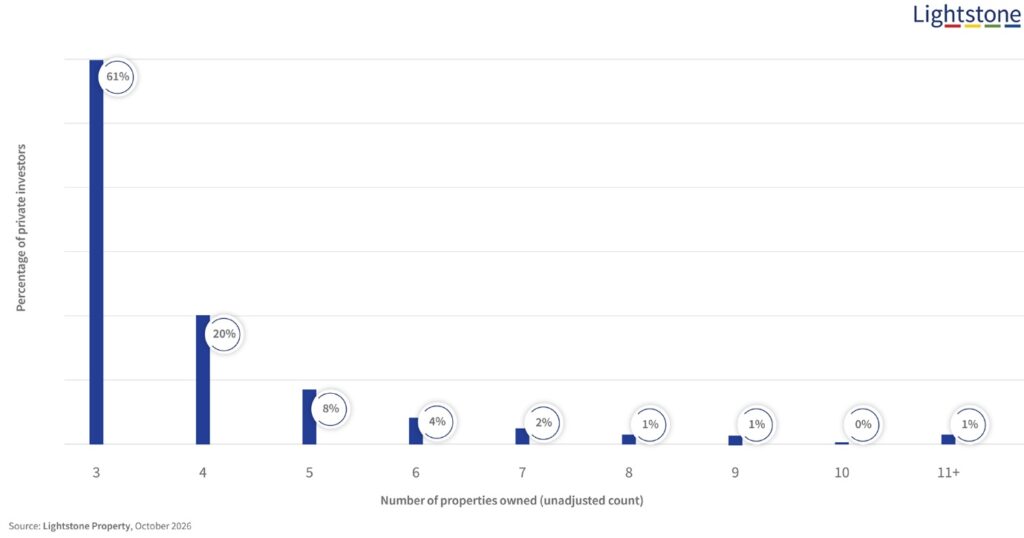
Lightstone found that approximately 61% of private property investors own three properties, while 20% own four and 8% own five. Only around 1% hold more than 10 properties.
The number of investors with three properties increased by 24% between 2015 and 2025. Meanwhile, investors holding 21 or more properties declined by 20%.
The average investment portfolio value, excluding the investor’s primary residence, also decreased from approximately R3 million in 2015 to R2.8 million in 2025.
This suggests a market where more people are participating without necessarily building large property portfolios.
For aspiring investors, the shift challenges the idea that property investment must begin with enormous wealth. It also highlights the importance of understanding affordability, financing and the long-term responsibilities that come with owning additional properties.
Home Is Where the Investment Starts
Another interesting finding is how closely investors tend to keep their property portfolios connected to their everyday lives.
Lightstone found that 64% of investment properties are located within the same municipality as the investor’s primary residence. Approximately four in five are within the same province.
Investors also approach their homes differently from their investment properties.
While 82% of their primary residences are freehold properties, 42% of their investment properties are sectional title units.
This points towards a preference for investment properties that may offer more manageable maintenance responsibilities and access to higher-density residential markets.
In practical terms, investors appear comfortable living in traditional standalone homes while looking towards apartments and sectional title developments when expanding their property portfolios.
The Wealth Conversation Is Changing
South Africa‘s private property investor pool is also ageing. Investors under 40 accounted for 15% of the market in 2015, compared with 10% in 2025. Meanwhile, those aged 70 and older increased their share from 6% to 10%.
This reflects the continued presence of established investors rather than a sudden disappearance of younger entrants.
The bigger story, however, is the changing demographic composition of the market.
Black women’s growing participation represents more than a statistical development. It opens up an important conversation about access to capital, financial literacy, representation and the different ways South Africans are approaching wealth creation.
Property ownership alone does not guarantee financial freedom, and the barriers to entry remain significant. But as more Black women enter the investment space, they are helping reshape the face of an industry that has historically been less accessible to them.
The next chapter of South African property investment may not be defined by who owns the most properties, but by how many more people can participate in building lasting financial security.