
AFHRI Reacts Positively to Lower Interest Rates in Q2 2025
The latest results of the Altron FinTech Household Resilience Index (AFHRI) for the second quarter of 2025 confirm some long-awaited relief for South African households. Although the index recorded a healthy 2.3% year-on-year improvement, the long-term pace of recovery since the Monetary Policy Committee began hiking interest rates remains slow, with the average annual increase in household financial resilience barely above zero.
However, modest declines in the prime lending rate have clearly assisted the AFHRI’s recovery, further highlighted in figure 1 of the report.
Household Financial Disposition Still Under Pressure
South Africa’s average annual population growth of 1.4% since 2014 has outpaced household financial improvement. High interest rates—at their highest in 15 years—dramatically raised debt-servicing costs, eroding disposable income.
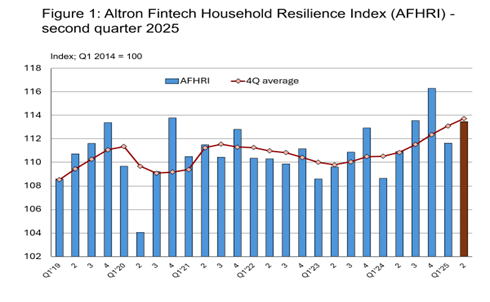
Compared to the last comparable quarter before the COVID-19 pandemic, household financial disposition has only grown by 0.5% annually in real terms, slightly below real GDP growth over the same period.
While the AFHRI’s annual increase of 1.1% since its inception in 2014 mirrors long-term GDP growth, households have underperformed the wider economy over the past 3.5 years.
Table 1: Average Annual Real % Change – AFHRI vs GDP
| Period | AFHRI | GDP |
|---|---|---|
| Since inception (Q1 2014) | 1.1 | 1.0 |
| Since pre-COVID-19 (Q2 2019) | 0.5 | 0.6 |
| Since rate hikes began (Q4 2021) | 0.2 | 1.2 |
Impact of the Two-Pot Pension System
The introduction of the two-pot retirement system in September 2024 produced a significant ripple effect across the economy. The system allows early access to a capped portion of retirement savings, while preserving the majority for long-term retirement planning.
Withdrawals are taxed at a member’s marginal tax rate. Although SARS initially projected R5 billion in revenue from these withdrawals, collections reached almost R13 billion by March 2025, far exceeding expectations.
This spike contributed to short-term boosts in household income, reflected by 35% and 40% year-on-year increases in lump-sum pension withdrawals during Q4 2024 and Q1 2025. Without these once-off income surges, AFHRI growth since the interest rate hiking cycle began would be close to zero.
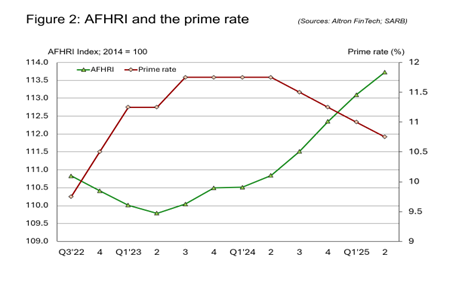
The relationship between interest rates and financial resilience remains clear. When the prime rate dipped to 7% in mid-2020, AFHRI rose sharply by more than 9%, moving from 104.1 to 113.8.
Conversely, high interest rates suppress household spending—South Africa’s largest driver of economic activity. As economist Dr Roelof Botha, compiler of the index, notes:
“The unduly restrictive monetary policy, in the absence of any sign of demand inflation, represents a self-imposed suppression of economic activity. This has resulted in two successive years of GDP growth below one per cent.”
With GDP forecasts for 2025 between just above zero and 1.3%, Dr Botha emphasises the need for additional rate cuts to stimulate employment and growth.
Q2 2025 AFHRI Performance Overview
The AFHRI evaluates 20 indicators of household financial resilience. Table 2 outlines real percentage changes since Q1 2020, quarter-on-quarter, and year-on-year.
Key highlights include:
- Civil debt defaults (reciprocal): +18.8% y/y
- Unit trust assets: +13.8% y/y
- Household wealth-to-income ratio: +7.1% y/y
- Household disposable income: +2.3% y/y
- Private sector employment: +0.7% y/y
- BetterBond house price index: –3.1% y/y
- Long-term insurance claims paid: –5.7% y/y
Despite mixed results, 15 of the 20 AFHRI indicators improved year-on-year, and 12 grew quarter-on-quarter, signalling broad-based improvement.
Stability Returns to the AFHRI
A notable positive trend is the stabilisation of the four-quarter average AFHRI value, now at 113.7, slightly higher than Q1 2025. The year-on-year increase of 2.6% shows a firmer recovery trajectory compared to previous quarters.
The prime rate cut to 10.75% in May 2025 delivered predictable improvements, lifting household resilience during the quarter and supporting private sector salaries and employment.
A standout performer was the 14% real increase in unit trust assets, reflecting a strong run on the Johannesburg Stock Exchange’s all-share index.
While long-term insurance surrenders rose by 5%, pension fund withdrawals have stabilised following the initial two-pot surge. Rising household disposable income (+2.3% y/y) also contributed positively.
Altron FinTech’s Outlook
Johan Gellatly, Managing Director at Altron FinTech, stresses that while improvement is visible, underlying pressures persist:
“While the year-on-year improvement is encouraging, the reality remains sobering – household financial resilience has improved by barely 0.2% annually since the interest-rate-hiking cycle began. The impact of the two-pot system, which generated R13 billion in tax revenue, has artificially inflated household incomes and masked what would have been an even weaker recovery.”
He adds that although the May rate cut provided relief, more aggressive monetary easing is necessary for meaningful employment creation and sustainable financial stability.